
How to read Paradise Lost
Some refreshers and advice before we begin the 2026 Paradise Lost slow read!

2026 is fast approaching, and so the Paradise Lost Slow Read is about to begin! In this post you’ll find a bit of framing context and advice for how to approach the text, and a reiteration of what my posts throughout the year will discuss, including a year-at-a-glance schedule and some previews of upcoming posts.
Selecting a version
Step one in reading the text is, of course, to choose which version to read! From my previous post introducing this slow reading project, here’s some notes on versions of the text:
Project Gutenberg is always there for us when we need free online versions of public domain lit, but I would caution against using this version, as it doesn’t include line numbers. Always go for an edition with line numbers!
I recommend instead using Dartmouth’s Milton Reading Room if you’re going to be going for an online version. For one thing, there are distinct pages for each book, which is a lot easier than the endless scroll of Project Gutenberg. There are also introductory materials including several short videos on this website that you can look through if you want some additional preparation before or while reading!
For anyone wanting a physical edition, the Penguin Classics edition is a good edition with a critical introduction but no footnotes; if you want the footnotes, which can be helpful for unfamiliar words and references, the Hackett Classics edition has a LOT.
Or, if you really want to commit to your Milton studies, consider the Oxford World’s Classics edition of The Major Works. This includes not only Paradise Lost, but several poems and prose works that I will be occasionally referencing in my posts throughout the year.
The main thing to consider when you’re choosing your version is footnotes. Do you want a visually clean version of the poem with only text on the page? Or do you want footnotes on the page that will give explanations and context as you’re reading? Whichever version you select, just make sure it has line numbers (more on that below).
And once you’ve secured your physical text or chosen an online version that looks good, it’s time to start thinking about how you’ll tackle the actual reading of the thing! Here’s some of my advice.
Embracing the “spoilers”

Usually with a book club like this, where we’re reading together chapter-by-chapter, I would want to keep things spoiler-free. But Paradise Lost is a unique case in this regard for a couple of reasons.
For one, this is a retelling of one of the most famous stories in the Bible. Original sin: Adam, Eve, the snake, and the fruit. Even for those of us who grew up outside of Christianity or, like me, outside of any organized religion at all, this is a pretty ubiquitous narrative. Few of us will be going into this unaware of who the characters are, or of what the outcome is.
And a second part of this text that complicates the idea of “spoilers” is the “Argument” included in each book. This is basically an epic tl;dr, a description of the major events contained within each book. It’s like the scene in True Lies when Arnold Schwarzenegger tells a dude in detail how he’s about to kill him, and then does exactly that. We’re not on the edge of our seat wondering how Schwarzenegger’s gonna do it; we’re waiting for the satisfaction of seeing an enactment of the action we’ve been promised.
Take away the suspense of wondering how the story ends, and you’re left with just the story itself. It’s the journey, not the destination, that you’re signing up for.
To that end, I’ll be including a plot synopsis (in modern English, unlike Milton’s) in the first post of each month. Going into each book with an understanding of what happens in it can help you more easily navigate the language, and focus on your observations and analysis rather than deciphering what exactly is happening.
Reading blank verse
Paradise Lost is written in what is called blank verse, a term which refers to unrhymed verse almost always written in iambic pentameter. Maybe these terms are bringing back all your memories of doing scansion while reading Shakespeare in class, but in case the memories are hazy, here’s a refresher on what this means:
When we are talking about poetic meter, we’re talking about the rhythm of a line of verse. How many syllables are there, and what is the balance of stressed and unstressed syllables? You get a “foot,” or a pattern of stressed/unstressed syllables. An iamb is a foot of an unstressed syllable followed by a stressed. The words about, unless, immense, express, are all iambs. Say them out loud, and you can hear the ba-BUM rhythm. The meter of a line depends then on how many times the foot is repeated. When the iamb is repeated 5 times, you get iambic pentameter!
So with Paradise Lost, you’ll see that every line has that ba-BUM rhythm repeated five times in a line, without the lines ending in rhyme.
Even if you don’t plan to use an audiobook throughout the whole reading process, you may want to listen to a bit of an audiobook at the start to get a feel for the language!
A note on line numbers
As I mentioned at the top of this post, whatever version of Paradise Lost you are working with, whether an online text or a physical copy, it is important that you choose one with line numbers.
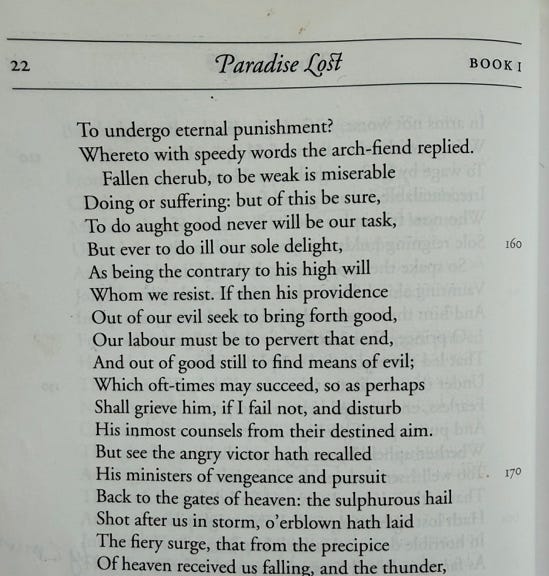
Whereas in a novel you would cite a quote with a page number to direct other readers where to find it, with narrative verse like an epic poem you use the book and line number. The beauty of that for a book club like this one is that it doesn’t matter that we’re all using different versions of the text – we can easily find the same quotes through following the line numbers! For example, if I wanted to reference a quote out of the passage above, there would be little use in my telling you that it’s on page 22 of my book. Instead, I could write: “If then his providence out of our evil seek to bring forth good, our labor must be to pervert that end” (I.162-4). You would then be able to go to Book I, line 162, and read the quote in context.
Reading Out Loud
In his introduction to the text, Philip Pullman writes about the musicality of the language of Paradise Lost, and the value of speaking the words aloud, even if you are struggling with their meaning:
The experience of reading poetry aloud when you don’t fully understand it is a curious and complicated one. It’s like suddenly discovering that you can play the organ. Rolling swells and peals of sound, powerful rhythms and rich harmonies are at your command; and as you utter them you begin to realize that the sound you’re releasing from the words as you speak is part of the reason they’re there. The sound is part of the meaning, and that part only comes alive when you speak it. so at this stage it doesn’t matter that you don’t fully understand everything: you’re already far closer to the poem that someone who sits there in silence looking up meanings and references and making assiduous notes.
Reading the text out loud creates intimacy between the story and yourself. It brings an embodied dimension to your relationship with the words on the page. Try it, at least once! I’m not saying you should read the entire thing out loud to yourself; just that as part of your process of getting acquainted with the text it’s worth bringing the words off the page and into the air around you.
Taking notes
In my Personal Curriculum guide, which paid subscribers received last week, I talk in more depth about the benefits of and approaches for establishing note-taking practices.
The simple version is: taking notes can allow you to engage more deeply with a text, helping with your understanding and analysis! If you are interested in taking notes on Paradise Lost, I recommend adopting the habit of keeping a list of any words or references that are unfamiliar to you or spark curiosity. This is a dense text, and even native English speakers will likely feel like there’s a bit of a language barrier. Early modern English on its own can feel unfamiliar, and since this is an epic it’s written in an elevated tone, creating additional challenge. But that’s part of the fun of a slow reading challenge! Unfamiliar language is an invitation to curiosity, not a sign of failed understanding.
Whether it’s in a Word document, a journal, or your phone’s Notes app, take note of any words, phrases, names, etc., you don’t recognize. Write down stray observations or questions that are occurring to you, or things this reminds you of. And then get on Google or JSTOR or Wikipedia or wherever, and start looking things up! Embrace the unknown, and embrace the urge to go on tangents, and just see where you end up.
A note on my perspective
While I will be drawing from scholarship throughout my posts here, this isn’t a formal scholarly project, and certainly not one in which I’m pretending to be unbiased. The posts you’re reading will be coming from me, Carson - subjective reader! So I want to take a moment to identify a couple of ways that who I am will probably be shaping what I write.
I’d like to note that while I have a PhD in English and specialized in early modern English lit, I’m not a Milton scholar. Literary research fields are incredibly specific! I spent most of my time in grad school focusing on drama, and even more narrowly on plays performed before 1642. I am not trying to present myself as an academic authority on Paradise Lost. I have more academic experience and training related to this text than most and I want to share that with my fellow readers, but I’d like to position myself as more of a hostess or curator than a lecturer!
Also, to be clear, I am approaching this text from a secular perspective. I will make reference to Biblical narrative and Milton’s theology, but my own relationship with this text is one of an atheist who has only sat in a pew as a child when I had to attend Sunday Mass after sleeping at my friend’s house on a Saturday, and as an adult at the occasional funeral or wedding. I welcome readers of all faith backgrounds (those of you who are Christians will definitely catch some references that go over my head!) but I want to be very clear that for me, Adam and Eve and Satan and God are characters in a book I’m reading.
And finally: I’m a woman dedicating a year of work to a text written by a man who would not have seen me as his equal. This is something I think about. Milton was better than some early modern writers in terms of how he saw women, but he was still…of his time. Yes, this is something I’m used to and no, I don’t think we should apply modern values and norms to centuries-old texts. But one of the things that is going to be on my mind, and occasionally in my writing, as I’m working through this project is that I am not the reader Milton imagined for his epic.
The Year Ahead
And now, a look at what’s ahead for this publication!
Our Schedule
Throughout 2026, we will read one book per month. Here’s what this will look like:
January: Book 1 (798 lines total)
February: Book II (1055 lines total)
March: Book III (742 lines total)
April: Book IV (1015 lines total)
May: Book V (907 lines total)
June: Book VI (912 lines total)
July: Book VII (640 lines total)
August: Book VIII (653 lines total)
September: Book IX (1189 lines total)
October: Book X (1104 lines total)
November: Book XI (901 lines total)
December: Book XII (649 lines total)
While, as you can see, some books are longer than others, the average pacing for our reading will end up being about 200 lines per week. In the first newsletter of each month I’ll include a recommended pacing breakdown dividing the month’s book into four sections that are roughly the same length without ending in the middle of a sentence.
Monthly Posts
Free subscribers will receive two posts each month: one at the beginning of the month in which I provide an introduction to the Book including a plot summary and discussion of some things to look for while you’re reading, and one at the end of the month in which I share my reading notes, highlight a passage for close reading, and pose questions for us to discuss in the comments.
Paid subscribers will receive an additional post every month dedicated to taking a closer look at the Book in question and/or discussing literary and historical perspectives that can help us better understand the text. Throughout each month, I will also be sharing additional resources and/or posing questions for discussion for paid subscribers in our subscribers’ chat.
All posts will be published on Fridays. My typical schedule will be to publish on the first, third, and fourth Fridays of the month, but in January we get five Fridays! So here’s when you can expect to receive the first month’s installments of Paradise Lost posts in your inbox:
Friday, January 2: Introduction to Book 1 (free for all readers).
Friday, January 23: Post for paid subscribers only.
Friday, January 30: Book 1 Reading Notes (free for all readers).
And here’s a preview of the topics I’ll be exploring in the first four essays of the year for the paid tier!
January: A walk through the life, times, and oeuvre of John Milton, including the 1634 play that contains a temptation scene with some parallels to Paradise Lost.
February: A discussion of the sublime and the abject in Book II’s presentation of the characters Sin and Death.
March: A closer look at the motifs of light and dark in Paradise Lost, including consideration of Milton’s blindness.
April: A discussion of the prelapsarian garden, and critical perspectives on the ecology of Eden.
If you’ve already chosen the edition of Paradise Lost you’ll be using during this slow read, what have you selected? Are you going with an online version, an audiobook, or a physical version? Seeking out footnotes, or going with a simpler version of the text? Let me know in the comments!
cover image: Milton, by Mihály Munkácsy, 1877-8
Just a heads up for those without the Oxford edition with Pullman's intro, it was published here https://publicdomainreview.org/essay/the-sound-and-the-story-exploring-the-world-of-paradise-lost/
I’ve never tried anything like this before, and I’ve definitely never read paradise lost (or even tried to) before. I just wanted to let you know I love the idea and have ordered myself a copy from a local bookstore. Thank you for doing this - should be interesting!