
Paradise Lost Book 6 Reading Notes
Let it profit thee to have heard by terrible example the reward of disobedience...

Slow Read Index | Paradise Lost Bibliography
Michael sliced Satan clean in half! Satan and the rebel angels invented cannons! Shots were fired, angels were wounded, mountains were picked up and hurled through the air, and in the end, the Son put such a beatdown on the rebels that they threw themselves into Hell rather than face his fury. We’ve reached the end of Book 6 and seen the whole War in Heaven unfold, and now it’s time to reflect on how this book fits into the larger story of our epic.
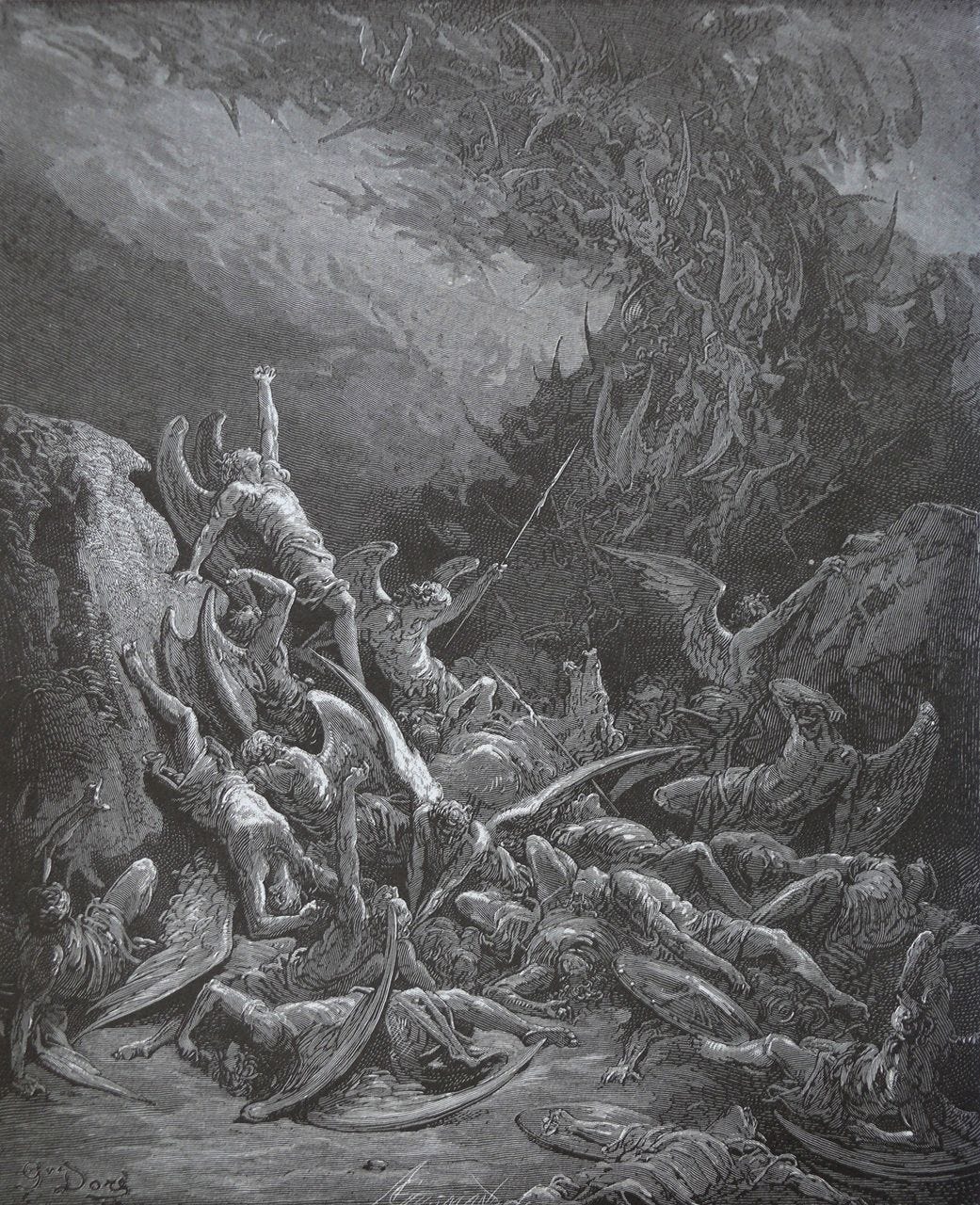

In this month’s intro post I gave some historical context on the English Civil Wars, a subject I dug into at more length in the post that got sent out to paid members last week. I’d love to hear analysis or questions about those historical parallels in the comment section, but in this post I’m going to focus less on warfare and more on character and structure.
One of the reading questions I posed in the introduction to this book at the beginning of the month was:
How does seeing the full backstory of the war in Heaven impact your reading of Satan as a character, and your understanding of where the narrative begins in Book 1?
The epic begins with that captivating in media res opening in Hell, putting us in the immediate aftermath of the fall from Heaven and introducing us to the narrative world through the fallen angels’ perspectives. While we’ve been talking about taking Satan’s descriptions of God with a grain of salt, and getting a more complete sense of the world of Paradise Lost as we see Heaven and Eden and meet more characters, it’s not until this book that we’ve been able to see the full picture of Satan’s fall.
For me, one of the key pieces of information we learn in Book 6 is that Satan and his fellow fallen angels weren’t technically hurled down into Hell by God or the Son. Rather, “headlong themselves they threw down from the verge of Heav’n” (6.864-5). The sheer force and rage of the Son was so powerful, and made them so terrified, that they jumped into Hell rather than continue to face that wrath. I can appreciate that narrative choice as a further illustration of the principle of free will. Not only was Satan’s rebellion his own choice, but even his fall from Heaven was his own active decision. God did not pick him up and hurl him down into Hell; Satan threw himself down. Knowing that, in retrospect, Moloch’s urgings for all-out war during the Infernal Parliament of Book 2 seem almost absurd. It’s worth looking back on the whole of Book 1 and that parliamentary debate in Book 2 with this new context in place. The fallen angels experienced two days of fighting, one day of being thoroughly defeated, and nine days of languishing in Hell without the strength to move, and then they began building Pandemonium and holding a strategy meeting. How do you read this? Is this representative of a resilient spirit of rebellion? A deep denial of reality? A foolishly overblown sense of confidence?
I also posed a question in my Book 5 reading notes relating to how the backstory affects our reading experience:
How is our own “knowledge” of this story being acquired, and why are we receiving information in a certain order? First getting the fallen Satan’s perspective, then a little commentary from God, then introduction to Eve and Adam, and now the backstory of the war…what impact does this order of events have on our interpretations of events and characters?
I feel that the Book 1 opening creates intimacy between reader and Satan. Hearing him speak about his suffering and grief humanizes him, and is part of what builds him into a compelling character. But I also think that the structuring of the plot enacts a kind of temptation for the reader. We get drawn in by Satan’s powerful speeches, his appeals to his fellow angels, his determination to make the most of a bad situation. Then in Book 4 we hear some of his bitterness towards Eve and Adam. In Book 5, we see his jealousy of the Son. And now in Book 6, we see him getting his ass kicked by the Son, by Michael, and even a little bit by Abdiel. Experiencing the story in this way forces us to confront our susceptibility to being swayed by Satan. What if he isn’t as sympathetic a character as he first appeared? What if we, like Eve, are just vulnerable to temptation, being led astray by the devil’s appeals?
This brings me to a surprise I had while reading Book 6. One of the parts of this epic that has long been emblazoned in my mind is Satan’s Book 1 “better to reign in Hell than serve in Heaven” speech. This is a banger of a line; it’s one of Satan’s greatest hits. When I made a video back in December evangelizing about the epic, I quoted this line to illustrate why Paradise Lost is worth reading; in September of last year, before I’d even dreamed up this slow read, I read part of the speech out in a different video! And yet, I didn’t remember the part of Book 6 when Abdiel is challenging Satan, and says:
Reign thou in Hell thy Kingdom, let me serve
In Heav’n God ever blest, and his divine
Behests obey, worthiest to be obeyed.
(6.183-5)
We hear the line from Satan first in the reading experience, but Abdiel says it first in the narrative timeline. This was a bit like learning that “Nothing Compares 2 U” isn’t a Sinéad O’Connor song - Satan is just repurposing Abdiel’s phrasing! I imagine these words echoing in Satan’s mind as he lies stunned for those first nine days in Hell, and as he looks around at his miserable new demesne. Perhaps he reflected, too, on Abdiel’s warning to “chains in Hell, not realms expect” (6.186). But, like some cover songs outshine the original (I’m looking at you, Johnny Cash’s version of “Hurt”) the idea of reigning in Hell is used to more compelling effect in Satan’s bitterly resolute speech in Book 1 than in Abdiel’s taunt in Book 6.
There’s a similar parallel slightly later in the war: when Satan is meeting Michael on the field of battle, he says that he and his rebels
Mean to win,
Or turn this Heav’n itself into the Hell
Thou fablest; here however to dwell free,
If not to reign.
(6.290-3)
At this point, Satan believes that Heaven can be turned into a Hell; after his fall, he will say that
The mind is its own place, and in it self
Can make a Heav'n of Hell, a Hell of Heav'n.
(1.254-5)
Force and rebellion could not turn Heaven into Hell, but when he first looks around after the fall Satan hopes that perhaps through strength of will, through a shift in perspective, he will be able to turn Hell into Heaven. We have these two moments wherein Satan is attempting to deny that he is limited by external reality, by the rules of God’s creation. He doesn’t have to serve in Heaven, he can dwell there freely! Okay, he’s in Hell, but he can make it into a kind of Heaven! He’d actually prefer to reign in Hell! With his Book 4 statement of “which way I fly is Hell; myself am Hell” (4.75), he may have reached a point of acceptance of reality, but we’ll just have to keep reading to see whether Satan continues to hope that he may be able to change or improve his situation…
So far, I’ve been talking about what we as readers are learning through the backstory in Book 6. What is Adam learning?
As we’re looking back over Book 6, we have to hold in mind that everything we are reading is what Raphael is telling to Adam in an attempt to warn him away from disobeying God (though this is an attempt that God and Raphael, and we, know will be futile). There is a purpose to this backstory beyond just filling in the gaps for the readers. The in-world intention here is to illustrate for Adam the danger that Satan poses.
Let’s look back at the point in Book 5 when Raphael agrees to Adam’s request for more information about the War in Heaven. For one thing, he leads Adam to make that request by first dropping a brief mention of the angels who were cast into Hell. This is pedagogically sound – guide your students to notice a worthwhile point of inquiry, rather than just lecturing them – and also contributes something interesting to how the text is presenting curiosity and knowledge. Adam must ask for the information before it is offered to him. And when Raphael does begin to provide the requested information, Raphael hedges a bit:
How shall I relate
To human sense th’invisible exploits
Of warring spirits…
How last unfold
The secrets of another world, perhaps
Not lawful to reveal?
(5.564-570)
Not lawful to reveal? I can easily understand Raphael taking a moment to pause over the difficulty of translating divine war into terms a human (and a pretty freshly made human at that) could understand. But why does he express uncertainty over whether it is “lawful” to reveal this information, when God sent him to Eden with the express purpose of doing this? Is this part of some rhetorical strategy to help Adam understand the importance of what is being revealed? Is Adam now listening to this story with the sense that he’s being let in on a big secret? Or that the rules are being bent for his benefit?
You’ll notice that I’m only talking about Adam here. God sent Raphael to Eden specifically to talk to Adam, with no mention of Eve. And while we never got a direct statement indicating that Eve left the table after the meal was finished, we do get these closing words from Raphael at the very end of Book 6 as he warns Adam to be cautious against Satan’s manipulations:
But listen not to his temptations, warn
Thy weaker; let it profit thee to have heard
By terrible example the reward
Of disobedience; firm they might have stood,
Yet fell; remember, and fear to transgress.
(6.908-912)
Warn thy weaker – meaning warn Eve, the “weaker” half of the married couple. I suppose it’s possible that Raphael is saying this while Eve sits silently listening, but that seems unlikely. To me, this is indication that Eve has left the table at some point either before or during the story, which means that she will rely on Adam relaying the information to her later. Once again, we see that Adam is granted a direct relationship with divinity and is expected to be curious, where Eve gets information and Heavenly contact only when it is mediated through her husband.
Is this going to be a problem? Are we going to see Adam deliver a warning to Eve? Are we going to see Eve at all in the next couple books? Only time will tell!
Before wrapping up this article, I want to take a moment to celebrate the milestone we’ve reached in the Paradise Lost slow read. We’re at the halfway point: six months and six books down, six months and six books to go!
I’m having so much fun with this reading project, and am finding it incredibly rewarding. I hope that the same is true for all of you! Six months into this reading experience, have there been any surprises for you? Any challenges, or rewards?
One of the unexpected results of this reading project for me is that I’m reading more this year than I did last year. I thought that spending so much time with Paradise Lost might mean that I read fewer books outside of this project, but instead the opposite is true! Are you finding that reading Paradise Lost is having an influence on your other reading habits? Do you have any favorite books you’ve read this year outside of this reading project? Let us know in the comments!
I also want to highlight a mid-year announcement I made to paid members early this month: I shared my plans to publish an Online Journal of Paradise Lost Slow Readers at the end of the year. Everyone in the paid tier is invited to submit a piece of writing (literary analysis, cultural criticism, personal essay, creative writing, or anything else you can imagine), and I will be compiling these submissions into a “journal.” The Online Journal will be published in late December as we conclude the slow reading journey, and will be available to all members. If you are interested in upgrading to paid to be part of this but have questions, please feel free to ask them in the comments!

What’s Next?
The War in Heaven is over, but we continue with the conversation between Adam and Raphael next month. Book 7 is the shortest of the entire epic, so July will be a nice light reading month for us – plenty of time to balance summer shenanigans with the slow reading schedule! For anyone looking to break the book into 4 roughly equal sections without breaking off in the middle of a sentence, you can use the following pacing:
Week 1: 1-173
Week 2: 174-328
Week 3: 329-484
Week 4: 485-640
We get another five-Friday month in July, so the articles will be slightly more spaced out. You can expect to receive posts on the following schedule:
Friday, July 3: Introduction to Book 7
Friday, July 24: on birth in Paradise Lost (paid members only)
Friday, July 31: Book 7 Reading Notes
I hope you will share your thoughts on Book 6, your reflections on reaching the midway point of the slow read, and any stray observations or analysis, in the comments here! As always, I’d also love to hear your thoughts on the reading questions I posed in this month’s intro post:
How does seeing the full backstory of the war in Heaven impact your reading of Satan as a character, and your understanding of where the narrative begins in Book 1?
If, as Michael says, Heaven is no place for the works of war, why is Heaven populated by armies of angels trained in combat?
Within the wider text, Book 6 is a story being told to Adam in order to warn him about the danger Satan poses. How do you imagine Adam receiving this information?
Abdiel is an original character Milton has created for this epic. What function do you think he serves within the wider story? What significance do you see in his interactions with Satan?
I answer your questions in my reading journal. To be honest this experience is teaching me to slow down with my reading. I’m a fast reader, but this slow read is teaching me habits that I’m carrying over to other books. I love it so much! Very excited about diving into book 7 and I loved your recent article on the English civil wars!
"Not lawful to reveal? I can easily understand Raphael taking a moment to pause over the difficulty of translating divine war into terms a human (and a pretty freshly made human at that) could understand. But why does he express uncertainty over whether it is “lawful” to reveal this information, when God sent him to Eden with the express purpose of doing this? Is this part of some rhetorical strategy to help Adam understand the importance of what is being revealed? Is Adam now listening to this story with the sense that he’s being let in on a big secret? Or that the rules are being bent for his benefit?"
Tempting Adam with knowledge that's "perhaps not lawful to reveal" is a risky rhetorical strategy given that Raphael is warning Adam to ignore Satan and to refrain from eating from the Tree of Knowledge.
Having said that, immediately after saying "perhaps not lawful to reveal", Raphael says "Yet for thy good / This is dispensed", 5.570-71, and at the end of his tale about the War in Heaven, Raphael tells Adam, "to thee I have revealed / What might have else to human race been hid", 6.895-96. Taken together, these statements explain why Adam hadn't been told about the War in Heaven beforehand. There was no need for Adam to know about it. Until then, it is "perhaps not lawful to reveal".
That's the best I can figure.