
Paradise Lost Book 7 Reading Notes
But knowledge is as food, and needs no less her temperance over appetite...

Raphael warns Adam in Book 7 that knowledge must be gained gradually and with moderation in mind, as intemperate appetite for knowledge “soon turns wisdom to folly” (7.129-30). So it’s a good thing we are reading slowly, tempering our appetite for Paradise Lost!
Over the past seven months of reading this epic, I’ve developed a routine in how I read each book. Right before the start of the month, I’ll skim through the entire book to refresh my memory so that I can write the intro post and divide the book into four sections. Then, every week, I read only the section of lines I’ve designated as the week’s reading; I’m “allowed” to read from the previous weeks’ lines or previous books, but I’m not “allowed” to read ahead. This habit means that I get to really spend quality time with every part of the text, one little bit at a time. It feels like seeing a large painting from afar, and then going up to stand close up and just stare at whatever is directly in front of you. You can’t really see the full scene being represented anymore, so you have to look at smaller details, consider the colors, the cracks on the canvas, the brushstrokes.
Usually as I’m enjoying my bite-sized sections of the text and writing up the notes that turn into articles, I end up going down research tangents, identifying passages I want to close-read, and jotting down questions about plot and character and language. But in July, my notes have been unusually sparse. Maybe it’s because this book is so brief, maybe it’s because so much of it is devoted to an inventory of animals, or maybe it’s because it’s the middle of summer and I’ve been spending less time at my computer and more time eating fried whole belly clams and trying to establish myself as my 10-month-old nephew’s favorite aunt…whatever the reason, I find myself at the end of this month with less to say than usual about what I’ve read!
So, before I get into my discussion of Book 7, I’m wondering: was the same true for you? Did you find this book any less eventful or attention-grabbing than the first half of the epic? Or do I chalk my reaction up to the distractions of summer?
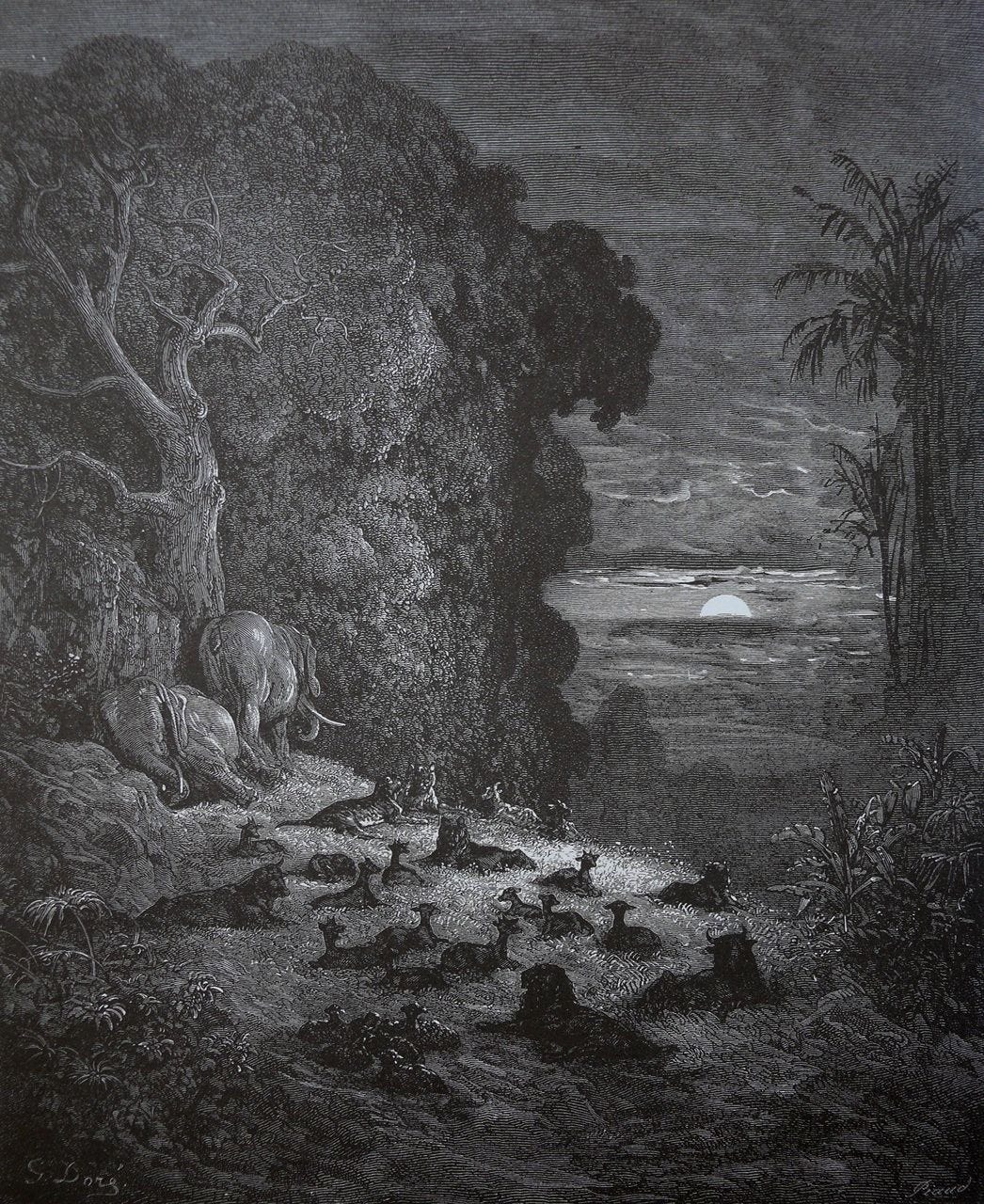
I’ll start my discussion of this book by just running through some of the points in the text that I’ve been marking up the most as I am annotating. These are lines or ideas that catch my attention, but that I don’t have full close-reading or analysis about.
First, these lines: “Whence Adam soon repealed the doubts that in his heart arose: and now led on, yet sinless, but with desire to know…” (7.59-61). I’m waiting to see the exact moment when Adam and Eve each move from “sinless” to “sinners,” and tracking the build-up to that moment in the meantime. These lines (and the surrounding ones) seem loaded with significance. How much doubt is allowed? Would it be possible for Adam’s desire for knowledge reach a sinful level of surfeit without his ever eating the forbidden fruit? What will be the precise point in the text when he is no longer sinless?
Another thing I have been marking my text up with scattered thoughts on: the presence of waste, or of some kind of scrap material, in the creation of the world. When the spirit of God first begins the process of creation, he infuses his vital warmth into the unformed void and “downward purged the black tartareous cold infernal dregs adverse to life” (7.237-9). Why are there infernal dregs adverse to life in the void in the first place? This is somewhat related to an ongoing point of interest that I have been intermittently researching for the past few months but haven’t worked out anything substantial to say about: theodicy. Theodicy: it’s more than just a Christopher Nolan movie!
Theodicy is the attempt to reconcile a belief in a loving and all-powerful God with the fact that there is evil in the world – “to justify the ways of God to man,” if you will. Why has Milton’s God created bad things? Why create a universe in which there is Death? Why populate the void with the antagonistic figures of Chaos and Night? Why fill it with tartareous dregs? Why create an Adam and Eve who are going to disobey, and then punish them for their disobedience? For me, it’s easy enough to resolve the presence of evil with the power of Milton’s God in a kind of dismissive way, by saying that God isn’t very sympathetic, and that I have my doubts as to whether he really did create absolutely everything or whether he is “coeternal” (3.2) with some of the other forces at play in the epic. But if I’m trying to consider Paradise Lost on its own terms, to read it through the in-world logic that there is an omnipotent and benevolent God, then I have to work through some consideration of theodicy. This will be an ongoing point of interest for me in the months to come, and as always I’d love to hear your thoughts on the subject in the comments!
My final stray point of interest: the serpent. In the catalogue of critters, the serpent is briefly described as the “subtlest beast of all the field, of huge extent sometimes, with brazen eyes and hairy mane terrific” (7.495-7). Why does the serpent get this vaguely menacing intro? I mean, I know why Milton gives it to the reader, but why does Raphael give it to Adam? Lions and tigers and crocodiles weren’t characterized as potentially scary, only the serpent. Is Raphael trying to nudge Adam into being a little suspicious of snakes?
The reason Raphael came down to Eden in Book 5 in the first place, after all, is to warn Adam that he is in danger of corruption. Not in the hopes of averting the fall (God has no hope of that happening) but just to ensure that Adam can’t claim to have been unaware. So maybe the subtle emphasis on the serpent is part of how Raphael is delivering this warning. Another part, surely, is through the emphasis Raphael puts on Adam’s status as master of all other creatures and his responsibilities of ruling the earth and obeying God. We know that Adam is already aware that he was given dominion over animals, that he was created first and Eve second, and that he has been forbidden from eating of the Tree of the Knowledge of Good and Evil. That means that in reading Raphael’s account of these things, we’re not reading him educating Adam as he was with the account of the world’s creation. What’s important is not the facts being conveyed, but the way this information is being reiterated.
One thing that caught my attention about the creation of humanity was the introduction to God’s announcement that the creation is about to commence:
Therefore the Omnipotent
Eternal Father (for where is not he
Present?) thus to his Son audibly spake.
(7.516-18)
The “audibly spake” suggests to me that God wants the angels to hear what he will say next. He and the Son could simply act as one, but God wants it clearly understood that man will be created in his image and will have authority over all of the natural world, and Raphael is sure to include that in the retelling. That authority is very clearly stated once Adam and Eve are formed, and in a more forceful way than I remember seeing previously in the text:
Be fruitful, multiply, and fill the earth,
Subdue it, and throughout dominion hold
Over fish of the sea, and fowl of the air,
And everything living thing that moves on the earth.
(7.531-4)
We heard Adam mention in Book 4 that he and Eve were given dominion over all other living things, but there’s something about how it’s framed and articulated here in Book 7 that makes the “dominion” feel much more dominating. They are tasked with filling the earth, subduing it, and ruling over every living thing. And we certainly get a substantial sampling of “every living thing that moves on the earth” in this book! I mentioned earlier the inventory of animals in Book 7 as being part of why I may have struggled to generate much in the way of notes and analysis this month. The nightingale, and the swan, and the cattle, and the lion and the stag and the crocodile and and and… it’s all as beautifully rendered into verse as usual, but it’s not a section of the text that I find particularly gripping. And that gives me the opportunity to question – what is it doing here? What purpose does this serve in the text?
What would you say? What do you think the extensive descriptions of the creation of various birds and beasts adds to the text? How does it fit in with wider themes or with the overarching story being told?
As I’ve been reflecting on this, there are a couple potential answers that emerge for me. One is that this listing of animals here mirrors the listing of demons we read in Book 1; the parallel could be serving to further underline the that the fallen angels are degraded and destructive while God’s loyal creations are joyful and serene. Another answer could be that through lingering over all these creatures and how they fit into the newly created world, Milton is emphasizing how high in the worldly hierarchy Adam and Eve are. When we read how humanity is created to be “chief” of all other works, we have a greater appreciation for just how many other works there are. And perhaps this emphasizes the weight of Eve and Adam’s responsibility, too. They are tasked with holding dominion over all other living things, of subduing the earth. And after reading 100 lines identifying so many of the other living things, and another 150 or so detailing the scale and majesty of the earth, we are primed to notice how weighty of a task this is.
Although, can I just say – no way are Eve and Adam subduing the whales. Logistics aside (how would they make whales participants in a vegetarian, gardening-based ecosystem?) I am fairly certain that there are no coasts in Eden. If the whales are outside of Eden, are they just having a grand old time outside the limits of humanity’s dominion? Are the orcas sneaking themselves a shark liver treat now and then since the humans aren’t around to be traumatized by the sight of violence? I have whale-based questions!
Speaking of coastal views and marine matters…
Part of the fun of the slow read for me in the past months has been seeing where there is overlap between Paradise Lost and the other things I’m reading. Sometimes those overlaps have been intentional (I’m reading lots of devil-y books) but sometimes, a little trend has emerged in my reading without my orchestrating it. This month, in our epic and in my other reading, it’s been all about the ocean.
My personal ocean motif started early in the month when, after finishing two emotionally heavy books back-to-back, I decided to cheer myself up with a pirate romance novel in which the heroine loves more than anything to be at sea. A couple days later I watched the lovely film Il Postino, which imagines a friendship between a local postman and Pablo Neruda when the poet comes to stay in a tiny Italian fishing village. This movie spurred me to pick my long-neglected copy of Twenty Love Poems and a Song of Despair off the shelf, and I found that Neruda’s poetry is filled with imagery of the sea: the loneliness of the docks at dawn, the eroticism of swelling waves, the destructive capacity of the ocean... Towards the end of July I made a trip back to visit my family in Rhode Island, the Ocean State, and I decided to bring with me a copy of Virginia Woolf’s The Waves, which intersperses descriptions of the coast within a long series of soliloquies. For good measure, I decided to toss in Rachel Carson’s The Sea Around Us, a kind of lyrically written marine biology book.
It’s that last book that has provided the most interesting bridge into Paradise Lost during the past month. Carson’s book contains its own narration of the formation of the earth:
When the moon was born there was no ocean. The gradually cooling earth was enveloped in heavy layers of cloud, which contained much of the water of the new planet. For a long time its surface was so hot that no moisture could fall without immediately being reconverted to steam. This dense, perpetually renewed cloud covering must have been thick enough that no rays of sunlight could penetrate it. and so the rough outlines of the continents and the empty ocean basins were sculptured out of the surface of the earth in darkness, in a Stygian world of heated rock and swirling clouds and gloom.
Different in many ways, of course, from Milton’s imagined version of events. But in both a 17th Christian epic poem and a 20th century book about the evolution of the natural world, there is a focus on the ocean as the origin of creation. There’s even a bit of overlap with the subject of this month’s paid article on reproductive imagery in Milton’s depictions of creation. One passage from Book 7 that combines the oceanic with the reproductive is the following:
The earth was formed, but in the womb
As yet of waters, embryon immature involved,
Appeared not: over all the face of Earth
Main ocean flowed, not idle, but with warm
Prolific humor soft’ning all her Globe,
Fermented the great Mother to conceive,
Satiate with genial moisture…
(7.276-82)
And from The Sea Around Us:
And as life itself began in the sea, so each of us begins his individual life in a miniature ocean within his mother’s womb, and in the stages of his embryonic development repeats the steps by which his race evolved, from gill-breathing inhabitants of a water world to creatures able to live on land.
Water and wombs, the emergence of life, and the power of the ocean. I find it very satisfying that even though Milton didn’t have anything even close to the information and context Carson did about the formation of the world, and even though he’s writing a story of faith rather than of facts, these two very different texts nonetheless both center the ocean in their creation stories.
Am I just focusing on the ocean because I’ve been watching the waves and reading about the sea lately? Or do the descriptions of the ocean strike anyone else as significant? Have there been any moments of overlap for you lately between Paradise Lost and any other books you’re reading?
What’s next?
The discussion of creation will continue next month. In Book 8 the remainder of the conversation between Adam and Raphael plays out, including Adam’s relation of his memories of how he basically birthed his wife through divine c-section (by the way, Eve can totally kill Macbeth).
For anyone looking to break this book into four roughly equal sections without breaking off in the middle of a sentence, you can use the following pacing:
Week 1: lines 1-158
Week 2: lines 159-318
Week 3: lines 319-490
Week 4: lines 491-653
Articles for the month of August will be hitting your inbox on the following schedule:
Friday August 7: Intro to Book 8
Friday August 14: further information on the Journal of Paradise Lost Slow Readers
Friday August 21: deep-dive article for paid subscribers
Friday August 28: Book 8 Reading Notes

I hope you will share your reactions to and analysis of Book 7 here in the comments! Please share any and all thoughts; as usual, here are the reading questions I posed in the Intro post if you’d like to start by responding to these:
What do you make of the specification that Adam’s curiosity is, at this point, “sinless?” Without having yet read the narration of the fall, what do you think would constitute “sinful” curiosity in this story?
What catches your attention about the creation narrative within this book?
Looking back on the first half of the epic, what themes, passages, points of interests, etc., seem most interesting or significant to you so far?
I thought the discussion of knowledge and curiosity fascinating. But I've already commented on that. So I'll bring up one final thought. We’ve discussed Milton’s paternalism, but it’s on full display in chapter 7 in the creation of humanity. Milton combines the two creation stories in Genesis in a way that trivializes women’s creation.
Genesis contains two creation stories, including two creations of humanity - one general and then Adam and Eve.
General creation
Genesis 1.26/27- And God said: ‘Let us make man in our image, after our likeness;…And God created man in His own image, in the image of God created He him; male and female He created them
Then in chapter2, God creates Adam and Eve. Adam from dust. "but for Adam no fitting helper was found. 21. So the LORD God cast a deep sleep upon the man; and, while he slept, He took one of his ribs and closed up the flesh at that spot. 22And the LORD God fashioned the rib that He had taken from the man into a woman; and He brought her to the man. 23Then the man said, “This one at last Is bone of my bones And flesh of my flesh. This one shall be called Woman, For from man was she taken.” 24Hence a man leaves his father and mother and clings to his wife, so that they become one flesh.” 2.20 -24
There is more than a touch of sexism in Genesis. But there is also the concept that men and women were created together (some ancient rabbis thought man was originally a hermaprodite - shades of Plato’s Symposium!). And while Eve was created after Adam, her creation was based on real need and to form a real partnership. There is tenderness in the scene with Adam being overjoyed and the two becoming "one flesh." (Note, the stuff in the Bible about serving the husband comes only after the fall.)
The two creations take about 30 lines.
Then we have Milton
PL ‘Let us make now man in our image, man [520] In our similitude, and let them rule…Male he created thee, but thy consort [530] Female for race, then blessed mankind.
About 10 lines. Eve isn't even mentioned by name through the end of Book 7. And apparently her only role is to procreate.
Just a heads up that there's a mild Godfather spoiler in my post below.
"My final stray point of interest: the serpent. In the catalogue of critters, the serpent is briefly described as the “subtlest beast of all the field, of huge extent sometimes, with brazen eyes and hairy mane terrific” (7.495-7). Why does the serpent get this vaguely menacing intro? I mean, I know why Milton gives it to the reader, but why does Raphael give it to Adam? Lions and tigers and crocodiles weren’t characterized as potentially scary, only the serpent. Is Raphael trying to nudge Adam into being a little suspicious of snakes?"
Perhaps the answer is in the remainder of Raphael's description of the serpent, "though to thee, Not noxious, but obedient at thy call." (7.497-98)
It reminded me of a quote from the Godfather when Don Corleone tells Michael, "So, Barzini will move against you first. He'll set up a meeting with someone that you absolutely trust, guaranteeing your safety. And at that meeting, you'll be assassinated."
Perhaps Raphael is telling Adam about when to be suspicious. By describing a "true" serpent, Raphael is implicitly describing a "false" serpent. A "false" serpent is noxious and though nominally obedient, isn't truly obedient to humanity's best interests. That's how Adam can discern whether a serpent is true or false.
But how does Raphael know to be wary of the serpent?
It's possible Raphael already knows about the role the serpent will play, though I don't see any evidence of that unless the quote itself is meant to be the evidence.
Another possibility is that Raphael doesn't know, but it's Raphael's way of saying that's what he would do if he were Satan.
Raphael knows that Satan "with lies / Drew after him the third part of Heaven's host", 5.709-10, and God told Raphael that Satan will try to corrupt Adam through "deceit and lies", 5.243. Raphael knows that the serpent is "the subtlest beast", characterized Satan's future efforts as an attempt to "seduce / Thee..from obedience", 6.901-02, but that Adam should "listen not to his temptations", 6.908. Raphael may also know that Satan was found, "Squat like a toad, close at the ear of Eve", 4.800, and Raphael told Adam to " warn / The weaker", 6.908-09.
Of course this is speculative and since most readers already know what will happen, it's not difficult to project onto Raphael something he isn't saying. But perhaps as "the sociable spirit", 5.221, Raphael is the angel best placed to understand how another angel could most effectively tempt humanity.