
Paradise Lost Book 2 Reading Notes
From her side the fatal key, sad instrument of all our woe, she took...

Slow Read Index | Paradise Lost Bibliography
As I sit to start writing up my reading notes for Book 2, the beginning of this book feels so far away. Was it really just three weeks ago that I was reading about the infernal council, considering the different arguments each of the devils makes about how to regroup after being cast out of Heaven? And now here I am watching Satan fly through Chaos while Sin and Death build a bridge behind him. With this slow pacing of the reading, I really feel like I’m going on my own epic journey through the text!
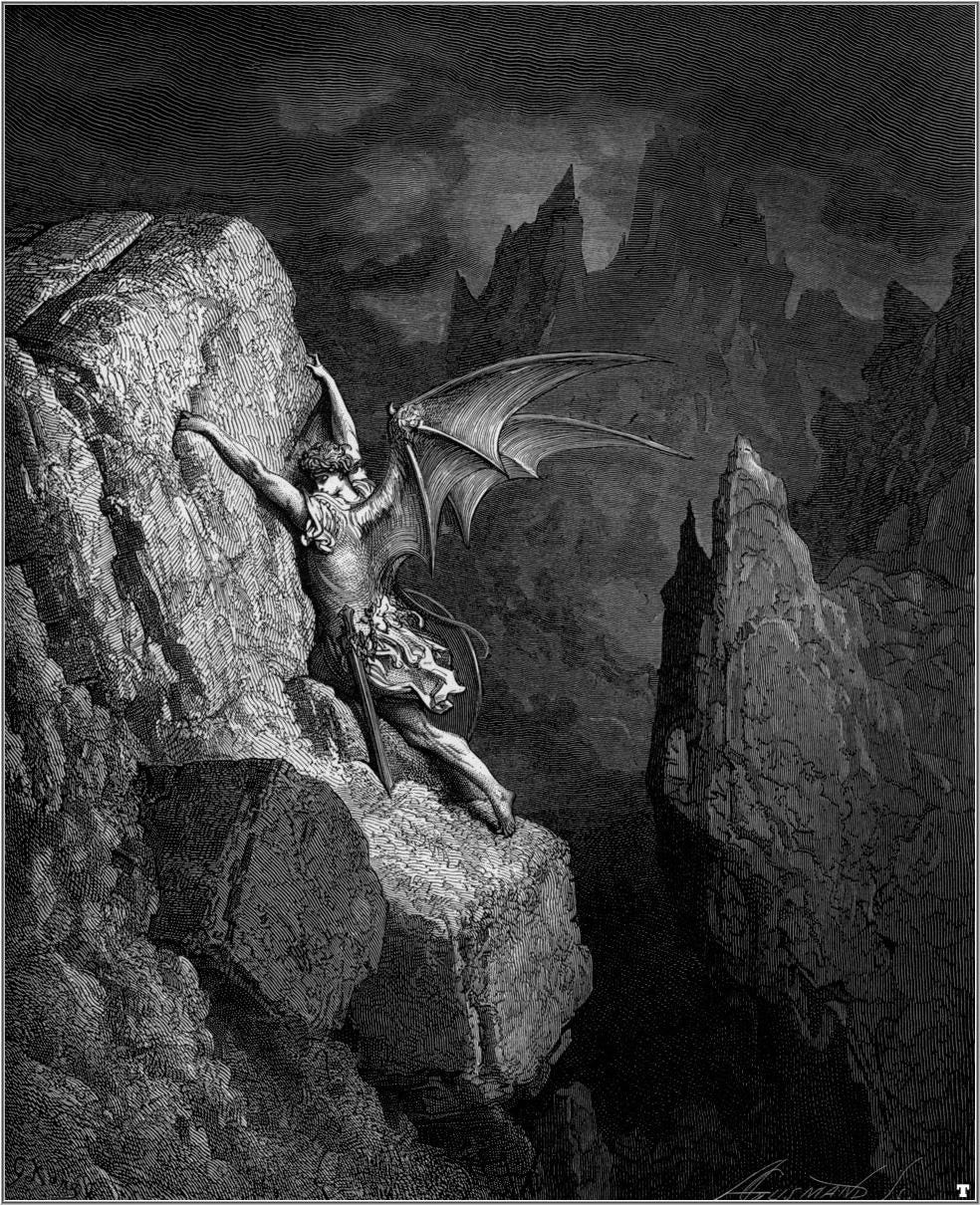
One of the reading questions I posed at the beginning of the month was: as you read the debate in Hell, are there any arguments that you find yourself agreeing with? Put a slightly different way, taking agreement out of it, we could ask: which of the devils is speaking the most persuasively or reasonably? We have Moloch’s argument for full-scale war, Belial’s for laying low, Mammon’s for making the most of Hell, and of course Beelzebub’s restatement of Satan’s plan for corrupting mankind…
When I reread the debate, I find myself going back to Belial’s speech the most. Maybe that’s partly because I do find him to be making some good points. Of all the fallen angels, he seems to most fully understand that God is watching all and controlling all (2.188-196), and that as bad as their current situation is, it can always be worse (2.164-174). And maybe Milton knew that he’d written Belial to sound a little too reasonable, given that he chimes in after Belial’s speech to remind us that this is still a devil, and his bad motivations undermine his surface-level logic (2.226-8).
But it’s not just my interest in parsing the logic of Belial’s argument that has me going back to his speech; there’s also one small section of this speech that I find really fascinating. He expresses a fear that if they anger God further,
We must exasperate
Th’Almighty Victor to spend all his rage,
And that must end us, that must be our cure,
To be no more; sad cure; for who would lose,
Though full of pain, this intellectual being,
Those thoughts that wander through eternity,
To perish rather, swallowed up and lost
In the wide womb of uncreated Night,
Devoid of sense and motion?
(2.143-151).
Belial is afraid that they will die. The angels were created to be immortal, but as I’ve said, Belial seems to be one of the few residents of Hell with an accurate appreciation of the extent of God’s power. And he fears that if they keep on pushing, God will fully destroy them and they will loose their eternal existence. It’s a little bit Hamlet-y to me,1 though Belial sees no chance of dreams in the sleep of death; instead, he fears being lost in “the wide womb of uncreated Night.” I’m becoming increasingly obsessed with all the references to wombs and birth in Paradise Lost (probably half of my contributions in the subscriber chat at this point have been me going, “look, another weird womby passage!”) and this is one of my favorites so far. Death as a womb that swallows up the intellectual being? I’m intrigued…
And, as it turns out, Belial’s fear that the angels might not be as immortal as they thought is well-founded. Because later when we meet the personification of Death, Sin will warn Satan:
O father, I forewarn thee, shun
His deadly arrow; neither vainly hope
To be invulnerable in those bright arms,
Though tempered heavenly, for that mortal dint,
Save he who reigns above, none can resist.
(2.810-14))
Satan may have been created immortal, he may have heavenly armor, he may have been able to shake off being physically thrown down into Hell. But Sin knows that only God is beyond the reach of Death’s powers.
And speaking of Sin…
In this month’s paid post and in the subscriber chat, we’ve spent a lot of time talking about Sin as a character. To what extent is she passive or victimized? What do we make of her relationship with Satan? Are the descriptions of Sin straight up body horror? (I say yes.) Here, I want to take a step back from thinking about Sin in terms of her character arc and motivations, and instead consider the figure of Sin, and the whole Unholy Trinity2 interlude, in the context of the overarching plot of the epic.
After he has received the full backstory about Sin and Death, it’s time for Satan to make his case for why he should be allowed to pass through the Gates of Hell. Satan says to his daughter:
I come no enemy, but to set free
From out this dark and dismal house of pain,
Both him and thee, and all the Heav’nly host
Of spirits that in our just pretences armed
Fell with us from on high…
(2.822-26)
We’re seeing here that, for one thing, Satan is still insistent that he and the other fallen angels were justified in their rebellion. We’re also seeing his persuasive abilities at work. He’s not asking Sin to do him a favor, he’s not requesting aid; he’s offering her an opportunity. He’s promising to set her and Death free. He even presents it as a sacrifice he is willing to make: he says he will “myself expose, with lonely steps to tread th’unfounded deep” (2.828-9). He will venture into danger in order to liberate the residents of Hell.
Death’s response to this is a “ghastly smile” (2.846); he seems to be pretty straightforwardly pleased with the prospect of being unleashed on the world to wreak destruction. But when Sin explains why she is agreeing to open the Gates of Hell despite having been by God “forbidden to unlock these adamantine gates” (2.852-3), her reasoning is less about ill-intention and more about questioning where her loyalties lie:
What owe I to his commands above
Who hates me, and hath hither thrust me down
Into this gloom of Tartarus profound,
To sit in hateful office here confined,
Inhabitant of Heav’n, and Heav’nly born,
Here in perpetual agony and pain…?
(2.856-62)
We’ve heard from the devils at length about their gripes with God, and their characterizations of him as tyrannical and violent. I find Sin’s argument here to be one of the most compelling, perhaps because it’s the most simple: what loyalty does she owe to one who has cast her into Hell? Why should she resign herself to a life of unending torture?
But I’m getting caught up again in analyzing Sin as a character when, as I said, I want to talk about this passage not at the level of individual motivation but in terms of wider significance in the epic.
For one thing, this passage invites us to really think about morality and free will within the world of Paradise Lost. Sin has been ordered not to open the Gates of Hell, but there’s nothing actually stopping her from doing it. It’s her choice to make, and it’s obvious to the point of feeling inevitable what choice she will make. In his discussion of this passage in the Cambridge Companion to Paradise Lost, John Rumrich writes, “rather than blame the personification of disobedience for disobeying, readers may wonder if God intends for Sin to obey his command when he entrusts her with the key, or if…his secret will is that she violate his ostensible command and actively abet Satan’s exit.”3
If it is God’s will for Sin to disobey, was it his will that Satan disobey? Will it be his will that Eve disobey? Because let us not forget, even though we’ve spent the past two months hanging out with Satan, this epic is telling the story of original sin. Of Eve eating the fruit. How does what we’ve seen so far about choice, obedience, and punishment inform how we are understanding personal responsibility in the world of the text?
And, just to hammer this point home: we’re building towards the moment when Eve will be persuaded by Satan to disobey to mandates of Heaven, and here in Book 2, at the Gates of Hell, we’re watching a woman make the decision to disobey God’s orders and instead follow Satan. Is this a precursor, or a parallel, to Satan’s temptation of Eve? What significance, if any, do you find in the fact that the personification of Sin is a woman? Do you read Satan as lying to or manipulating Sin in this moment, or is he speaking what he believes to be truth and logic?
What’s Next?
We’ve closed out Book 2 with Satan making his way towards the distant new world, bent on discovering the newly created humans in their garden. We still have a little ways to journey before we actually meet Adam and Eve, but Book 3 is going to give us new characters and a new location: it’s time to pop into Heaven and meet the character of God! At this point we’ve heard a lot about God, but now we’re finally going to hear from God. This is going to give us even more opportunity for character analysis, and for thinking about how the epic is building out the story of original sin.
To be totally honest, Book 3 is one that I don’t usually reread for fun. When I think about the epic as a whole, and the parts I love most, this book just isn’t one that I tend to gravitate to. But for that reason, contradictory as it may seem, I’m really looking forward to the month of reading ahead. Already with the first two books, the process of reading slowly and discussing in detail has led me to notice passages or ideas that I haven’t before, and to appreciate the text in a new way. And that’s with two books of the epic that I am very familiar with and fond of – I can’t wait to see what I notice for the first time while reading Book 3! I fully expect I’m going to get to the end of March with a fresh appreciation for the book.
We’ve got a shorter book ahead of us in March: only 742 lines in total, which means an average of 185 per week. For anyone breaking the reading down into weekly segments, the first segment that we’ll read and discuss next week will be lines 1-182.
The posting schedule for March will be as follows:
Friday, March 6: Intro to Book 3
Friday, March 20: Light, Dark, and Blindness in Paradise Lost (available to paid subscribers only)
Friday, March 27: Book 3 Reading Notes
As we get farther into the year and deeper into the epic, don’t forget that you can refer back to the Paradise Lost Slow Read Index to find all posts in one place!
Within this post I’ve raised a number of questions, all of which I would love to hear people’s thoughts on in the comments! I’ll also close out here by offering a couple more questions for your consideration:
To what extent do you read the devils’ debate as a mockery of political debate, as opposed to a more straightforward representation of a political exchange of ideas?
We know that Milton was a staunch supporter of the Parliamentary government in the English Civil War, that he opposed the monarchy and believed governments should enact the will of the people. Does that knowledge factor in to how you interpret the devils’ debate?
How does this book continue to develop Satan as a character? Are your views on him from Book 1 challenged or affirmed by your reading this month?
What effect do you think it has on your reading experience that God is absent from the page so far, and that we’re learning about him largely through the comments of his enemies? Why do you think that narrative decision might have been made?
Hamlet 3.1.64-96
Many readers and scholars have pointed out that Satan, Sin, and Death form a kind of evil inverse of the “holy trinity” of the Father, the Son, and the Holy Spirit.
Quoted at page 35 of the Cambridge Companion to Paradise Lost
Maybe it's because of current events, but I don't see Satan as a compelling (attractive? charismatic?) character. Perhaps, if the state of the world were different and we had different leaders, I might find his arguments more enticing, but the idea of "Let’s ruin everything because I'm mad at God" just makes me tired. Like, oh Satan wants to make a mess of things? How edgy. Yes, I know God has a big plan to redeem the world through Satan's actions, but also, Satan wants to ruin things for people because he's spiteful and that rubs me the wrong way in this year of 2026.
This book left me with 2 main takeaways. The first is how the interactions with sin and the devils don't just provide a criticism of monarchy, but of limited monarchy. Satan is able to use the theater of real debate as an opportunity to paint himself as a martyr and hero when all he's doing is what he wanted to all along.
Secondly, I love seeing words that have changed meaning, or feel more modern than the work they're in pop up in classic works. My version has a smorgasbord of them on one page beginning on line 951 with hubbub, demogorgon, and discord all flashbanging me back to back